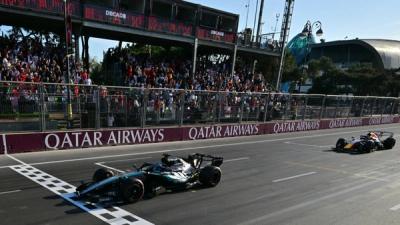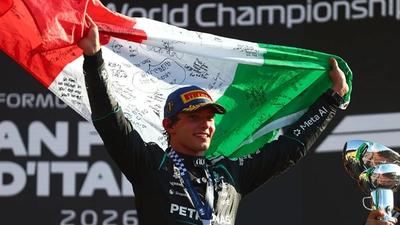
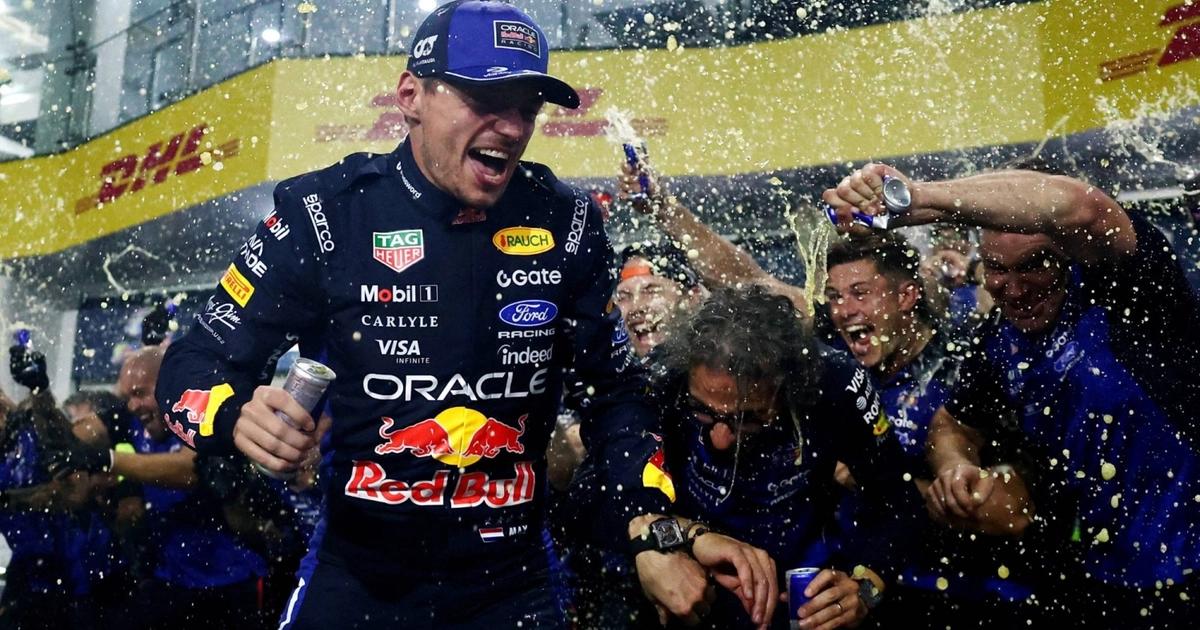
Max Verstappen won the Bahrain Grand Prix in Malaysia on Sunday, converting pole into Red Bull's first victory of 2026 after a start delayed by more than an hour and a half. Kimi Antonelli finished 2.307s behind in second, and George Russell's power-unit failure in the closing laps pushed the Mercedes driver's lead out to 84 points with seven rounds left.
Lewis Hamilton completed the podium for Ferrari after dropping more than a minute off the lead in the opening laps.
It was Verstappen's 72nd career win and his first since Abu Dhabi last December. It also extends a curious streak: he won the last Formula 1 race held at Sepang, in 2017, and has now won the next one there, nine years later. Sepang was brought back to replace the cancelled Bahrain round, which is why the race kept Bahrain's name.
The start that wasn't
A tropical storm flooded the circuit before the scheduled start, and this was the first time the 2026 cars had raced in the wet. The new power units, with close to a 50-50 split between electrical and combustion output, failed that test before the race had even started.
After a 45-minute delay the field set off behind the safety car for two formation laps. Several cars then stalled or lost drive at low revs, Hamilton and Verstappen among them, along with Ferrari-powered cars at Haas and Cadillac. Hamilton had to reboot his car on track. Verstappen reported he could not accelerate. By the time the cars returned to the grid, the order was scrambled and some cars were a lap down.
Race control suspended the start. According to [The Guardian](https://www.theguardian.com/sport/2026/oct/04/max-verstappen-wins-chaotic-f1-bahrain-gp-in-malaysia-after-rain-causes-farcical-scenes), it took another 53 minutes to re-sort the grid while the FIA pushed revised software parameters to every car. The fault traces back to the anti-traction-control logic in the engine software, which could not handle the low-rev, low-grip running that wet conditions force on drivers.
Inters or slicks
When the race did get under way, roughly half the grid took intermediates and half gambled on slicks. Both Mercedes drivers jumped Verstappen at Turn 1, with Antonelli taking the lead and Russell slotting into second.
Hamilton, starting second on soft slicks, had no grip at all and fell to 17th, as much as 80 seconds behind the leader. Charles Leclerc dropped all the way to last. Williams went the other way: on inters, Alex Albon and Carlos Sainz ran sixth and seventh in the early laps.
The race turned on lap nine. Valtteri Bottas slid his Cadillac into the gravel, the safety car came out, and almost the whole field pitted for slicks, with Antonelli on mediums and Verstappen on softs. Verstappen went round the outside of Antonelli through Turns 1 to 3 at the restart and controlled the race from there. He briefly lost the lead during his final stop but took it back straight away, and also set the fastest lap.
"It was very hectic with a lot of different things, but we made the right call with the inters," Verstappen said, according to [RFI/AFP](https://www.rfi.fr/en/sports/20261004-verstappen-claims-first-win-of-year-in-chaotic-bahrain-gp-in-malaysia).
It caps a remarkable recovery for Red Bull. The RB22 was a handful in the first half of the season, and Red Bull Powertrains' first in-house engine has quietly become one of the strongest combustion units on the grid. [The Race](https://www.the-race.com/formula-1/winners-and-losers-from-f1s-2026-bahrain-gp-in-malaysia/) rates it the best on the grid.
I'm Alex Da Costa, a systems engineer with more than ten years of experience designing and maintaining data-heavy infrastructure. I've been watching Formula 1 since the 2005 season — Alonso's first championship, the year Schumacher's seven-title era finally cracked — and it's been an obsession ever since. Pit Lane F1 is what happens when that IT background meets a lifelong F1 habit. I started this site because the big outlets cover the headline result but rarely the data underneath: why a pit-stop window mattered, how a circuit's lap-record history actually compares, what every driver has done at every venue. So I built it. Race recaps for every Grand Prix since 1950, head-to-head career comparisons, telemetry replays for 2024 onward, and per-circuit deep dives — all from open data sources, fact-checked against multiple references, and written in plain language. The site is run independently. No team, driver, or commercial partner influences what gets published. If you spot a factual error or want to suggest a feature, the contact page is the fastest way to reach me.