There are drivers who shaped an era, and there are drivers who become inseparable from the sport itself. Ayrton Senna belongs to the second category. Three world titles, sixty-five pole positions, forty-one Grand Prix victories, and a fatal crash at Imola in May 1994 — the bare biography fits in a sentence. The reason his name still travels through every Formula 1 paddock more than three decades after his death does not. To understand Senna is to accept that what he gave to motor racing was something close to a state of mind: an intensity, a religious seriousness about the act of driving, and a refusal to acknowledge any limit other than the next one.
This is the long version of his story, told from the karts of Interlagos to the Tamburello wall.
Part One — The boy from Santana
A São Paulo upbringing
Ayrton Senna da Silva was born in São Paulo on 21 March 1960, the second of three children of Milton Theodoro da Silva and Neyde Joanna Senna. The family was prosperous. Milton ran businesses in metallurgy, construction, and later in automobile imports; the household was middle-to-upper-class and lived comfortably in the Santana district of northern São Paulo. Senna's older sister Viviane and younger brother Leonardo would grow up in a home where children were expected to be disciplined and where money was never the constraint that defined what was possible.
Ayrton was the family nickname-magnet — Beco to the people closest to him. He was small, watchful, slightly shy in a way that surprised people who would later see him on television. From the start there was something different about how he handled physical objects. His mother described a boy who "had what he wanted, so he could do what he wanted" — a child who paid attention in class precisely so he wouldn't have to study at home, freeing up the afternoon to disappear with the family go-kart.
That kart, the foundational object of his life, was a present from his father. Milton — sensing the obsession early — built him a small frame around the engine of a household lawnmower. Ayrton was four years old. He would drive it around the family property until the petrol ran out, then ask for more. By ten he had a real kart, and by thirteen — the youngest age at which he was legally allowed to compete — he was on a starting grid.
What he showed his father, even before there was anything resembling a track, was an instinct for the machine. He did not crash. He did not over-correct. He did not fight the kart so much as listen to it. The intensity that would later define him was already there in miniature: the willingness to do the same lap over and over, adjusting one variable at a time, until something moved.
Tché and the karting years
The mechanic and mentor who shaped his early years was Lucio Pascual Gascón — known to everyone as Tché — who became Ayrton's first racing father. Tché taught him that a kart wasn't won by the engine alone. It was won by the carburettor jet, the chain tension, the brake-pedal feel, the seat angle. Senna absorbed it with a seriousness that would later baffle Formula 1 engineers. By his late teens he was the kid who stayed in the workshop until midnight checking his own kart, then drove home and slept four hours.
The results came quickly. He took the South American karting championship in 1977 and again the following year. He was twice runner-up at the Karting World Championships, in 1979 and 1980 — the closest he ever came to a karting world title. Karting nevertheless served the function it was supposed to serve. By the time he was twenty he had developed the racing instinct of a much older driver and the technical literacy to talk to engineers as equals.
Soy Alex Da Costa, ingeniero de sistemas con más de diez años de experiencia diseñando y manteniendo infraestructuras intensivas en datos. Sigo la Fórmula 1 desde la temporada 2005 — el primer título de Alonso, el año en que la era de los siete campeonatos de Schumacher por fin se quebró — y desde entonces es una obsesión.
Pit Lane F1 es lo que ocurre cuando esa base IT se cruza con una afición de toda la vida. Empecé este sitio porque los grandes medios cubren el resultado de portada pero rara vez los datos que hay debajo: por qué una ventana de boxes fue decisiva, cómo se compara realmente el historial de récords de vuelta de un circuito, qué ha hecho cada piloto en cada trazado. Así que lo construí. Resúmenes de cada Gran Premio desde 1950, comparativas piloto-vs-piloto, repeticiones telemétricas desde 2024 y análisis por circuito — todo a partir de fuentes de datos abiertas, contrastadas con varias referencias y escrito en lenguaje claro.
El sitio funciona de forma independiente. Ningún equipo, piloto ni socio comercial influye en lo que se publica. Si detectas un error factual o quieres sugerir una funcionalidad, la página de contacto es la vía más rápida para llegar a mí.
In 1981 he made the decision that defined the rest of his life: leave Brazil for England, the centre of single-seater motorsport. He went to compete in Formula Ford 1600. The cultural distance was enormous — a São Paulo boy from a comfortable family taking a small flat in Norfolk, dealing with English weather and English food, racing every weekend on tracks he had never seen. He won the championship at his first attempt.
He briefly considered quitting. The homesickness was real, and his father was happy to have him back in the family business. He returned to São Paulo for several months in late 1981, attended business administration classes, and seriously weighed a future in commerce. The decision to go back to England in 1982 was therefore not the inevitable choice of a born racer; it was a considered second commitment, made with the full knowledge of what it cost.
Once he was back, he won everything he entered. The 1982 Formula Ford 2000 seasons in both Britain and Europe were not so much campaigns as demolitions. By the end of that year, he had been adopted into the British single-seater establishment as the South American kid who simply did not lose.
Formula 3 and the Macau benchmark
The 1983 British Formula 3 Championship is the season that should be studied by anyone who wants to know what Senna was about. He won the first nine races of the year. Martin Brundle, in an arguably equal car, fought back so hard through the middle of the season that the title came down to the final round. Senna won. The way he won it told the paddock everything it needed to know — flat-out commitment from the first lap of qualifying, an engineering intelligence that demanded multiple set-up changes per session, and a willingness to drive over the limit and stay there.
The season ended with the Macau Grand Prix, a one-off Formula 3 race on a street circuit that has functioned for forty years as a graduation ceremony for future F1 stars. Senna won, ahead of Roberto Guerrero of Colombia and Brundle. His name was already known in Formula 1 paddocks. After Macau, it was no longer a question of whether he would arrive. It was a question of how soon.
Part Two — Toleman, Lotus, and the making of a legend
1984 — Toleman, and a wet afternoon at Monaco
Senna had test-drive offers from several teams at the end of 1983, and ended up signing with Toleman, a small British team running Hart engines and modest expectations. His teammate was Johnny Cecotto, the former motorcycle world champion. To Senna, sitting in a Formula 1 cockpit was a gift from God — the phrase he used when describing the feeling, characteristic of him, religious in its choice of words. He had grown up imagining the moment, and now he was inside it.
Toleman was a midfield team in a year of midfield struggles. He scored his first championship point at the second round at Kyalami, the South African Grand Prix. Two months later, on 3 June 1984, he announced himself to the world.
The Monaco Grand Prix of 1984 was run in conditions of ferocious rain. Senna qualified thirteenth. The circuit's unspoken rule — that you cannot overtake at Monaco — does not apply when half the grid is aquaplaning. He carved through the field with a calm that was visible even on the muddy television feed. By the time the race was stopped on lap thirty-one because of the deteriorating conditions, he was second on the road, closing on the leader Alain Prost at a rate of seconds per lap. Prost, on the pit wall, was waving urgently at the officials to suspend the race. Race director Jacky Ickx complied. Senna lost the race that everyone who watched it remembers him winning.
It did not matter. By the next morning, the paddock had a new vocabulary item: Magic Senna. He took two further podiums that year, at Brands Hatch (Britain) and Estoril (Portugal), and at the end of the season he won an unofficial demonstration race at the Nürburgring — the Race of Champions run for the launch of the Mercedes-Benz 190E, in which every driver was given identical machinery — beating, among others, Niki Lauda, Carlos Reutemann, Alan Jones, Denny Hulme, Elio de Angelis, Keke Rosberg, and Stirling Moss. Equal car, every benchmark of the previous twenty years on the grid. He won.
1985–1987 — Lotus, Honda, and the wet-weather dimension
For 1985 he was in a Lotus-Renault — the team of Jim Clark, Graham Hill, Mario Andretti — and the partnership delivered immediately. His first F1 victory came at the second round of the year, the Portuguese Grand Prix at Estoril, in conditions that made Monaco 1984 look benign. He led from pole, lapped almost the entire field, and finished with Michele Alboreto in second place a full minute and ten seconds adrift, the only driver not lapped. He won again that year at Spa-Francorchamps, another circuit where rain, gradient, and risk converge.
The Lotus pattern of 1985, 1986, and 1987 was: Senna would qualify on pole or near it; the team would build a car that was a fraction below the McLarens and Williams over a race distance; mechanical reliability would intervene. He took two further wins in 1986, eight pole positions, and finished fourth in the championship. In 1987 — the year Honda turbo power began to dominate — Lotus took on Honda engines and Senna won his first Monaco Grand Prix, a race that would later become his personal property. He won again at Detroit. He finished third in the championship.
By the end of 1987 the press had stopped describing him as a promising young driver. He was being talked about as the most talented driver of his generation, possibly any generation. Honda wanted him on its top team. McLaren wanted him next to Prost. The deal was signed before the lights went out at Adelaide.
Part Three — McLaren, Prost, and the championship years
1988 — Eight wins, MP4/4, and the first title
McLaren in 1988 was the team to be on the grid. Ron Dennis ran the operation with the discipline of a Swiss watch factory; Alain Prost was the reigning two-time world champion, the man the paddock called the Professor for the methodical exactitude of his approach to a race weekend. Honda had built a turbo engine of cathedral complexity. The chassis, the MP4/4 designed by Steve Nichols and Gordon Murray, was the most dominant car of its era. Of sixteen Grands Prix in 1988, McLaren won fifteen.
Ron Dennis had hesitated between Senna and Nelson Piquet for the second seat. The deciding factor was Honda — Honda wanted Senna — and Senna's relationship with the engine partner became the foundation of his time at McLaren. From the first race the dynamic with Prost was complicated and would never become simpler. Prost was older, more experienced, calmer, and in the early races of the season had a small but consistent edge over the new arrival. Senna spent the first quarter of the year studying his teammate the way he had studied a kart engine in 1976 — rebuilding his approach to brake balance, qualifying laps, race strategy.
The Monaco Grand Prix of that year is one of the most celebrated and one of the most painful afternoons of his career. He out-qualified Prost by 1.427 seconds — in identical machinery. The gap was so large it was as though Prost had been driving a different car. In the race, leading by enormous margins from the start, Senna was pulled in by a moment of inattention, lost concentration in the tunnel, and crashed at Portier. He walked back to his apartment and reportedly did not speak to anyone for three hours. He told the writer Gerald Donaldson years later that the experience was the moment in his career when he understood, with full force, the gap between what he could do and what was being asked of him in a championship campaign. He emerged from that day a different driver.
What followed was a streak of six wins in the next eight races. He took eight victories in total, finished first in the standings, and clinched the title with a remarkable drive at Suzuka. He had stalled at the start, dropped to fourteenth, and recovered through the race in light rain to overtake Prost on lap twenty-eight and take the win and the title. Asked later about the closing stages of that race, he said something that would become a refrain throughout his career: he had begun to thank God for the experience as he was driving. He felt a presence. He saw something, he said — visualized something — that had stayed with him.
That description of the 1988 Suzuka victory was as close as he ever came to confirming, on television, what those who knew him already understood: that for Senna, the act of driving was a religious one. He was a deeply Catholic man. He read the Bible most days. He often crossed himself before getting in the car. He did not consider this performance for cameras, and he was offended when journalists treated it as such.
1989 — The fracture with Prost
The 1989 season was the year the friendship — to the limited extent it had ever been one — broke. Prost felt Senna lacked loyalty. Senna felt Prost was using paddock politics in ways he found distasteful. The Brazilian had what the Frenchman lacked: the willingness to attempt a move that the rule-book had not yet decided how to handle. The Frenchman had what the Brazilian lacked: an ability to operate the political machinery of the FIA and the team in his own favour. Both knew it.
The trigger was the San Marino Grand Prix at Imola. The two had reportedly agreed pre-race that whoever led into the first corner would not be challenged at the restart after a red flag. Senna led at the start, the race was red-flagged, and at the restart Prost led briefly before Senna passed him at Tosa. Prost was furious. He felt the gentlemen's agreement had been broken. From that day, the two stopped speaking to each other in any meaningful way.
The championship came down, again, to Suzuka. Senna had to win to keep his title hopes alive. Prost led; Senna closed; Senna dived inside at the chicane before the start-finish straight, and Prost — perhaps anticipating the move and choosing not to leave space — turned in. They collided. Prost climbed out. Senna, whose car was still running, had to wait for marshals to push him back onto the circuit, returned to the pits, fitted a new nose cone, and fought back to overtake Alessandro Nannini for the win. Hours after the race the FIA, presided over by Jean-Marie Balestre, disqualified him for cutting the chicane and not completing the full racing distance. Prost was champion.
The Senna-Balestre confrontation that followed was one of the most personal and bitter in F1 history. Balestre demanded apologies. Senna threatened to leave the sport. Only Ron Dennis persuaded him not to. Speaking later, Senna would describe the period as the hardest of his career — not because he had lost a title, but because he felt the politics he had always tried to stay distant from had reached in and decided his fate. In one of the most-quoted lines of his life, he said simply: when your values are correct values, walking away from the dark forces you face in life just doesn't become an option. He stayed.
1990 — Suzuka, again
For 1990, Prost left McLaren for Ferrari. Senna took his second world title at the same circuit where his first championship had been settled and the second had been taken from him. The closing details of that title contain, in compressed form, a great deal of who he was.
He took pole at Suzuka. He immediately complained to the stewards that the pole position was on the dirty side of the grid — the right side, less rubbered-in than the left, where Prost would start. He asked for the pole-side to be moved to the cleaner racing line. He was refused.
He decided. He went into the meeting Sunday morning saying, in effect, that today would have to be his way. At the start, Prost made the better launch and led into the first corner. Senna kept the throttle pinned, drove his McLaren straight into the back of the Ferrari, and took both cars off the circuit at high speed. Both retired. Senna was champion.
It was, by any rational measure, deliberate. He admitted as much a year later, with an anger that had not left him: if you are no longer prepared to go for a gap that exists, he told the press in Adelaide 1991, you are no longer a racing driver. The line entered the lexicon. People have been reading it as poetry since. He was, in 1990 at Suzuka, not interested in poetry. He was interested in a championship that had been taken from him in 1989, by a sport that, in his eyes, had not played fair.
1991 — The third title, Interlagos, and the deepest race of his life
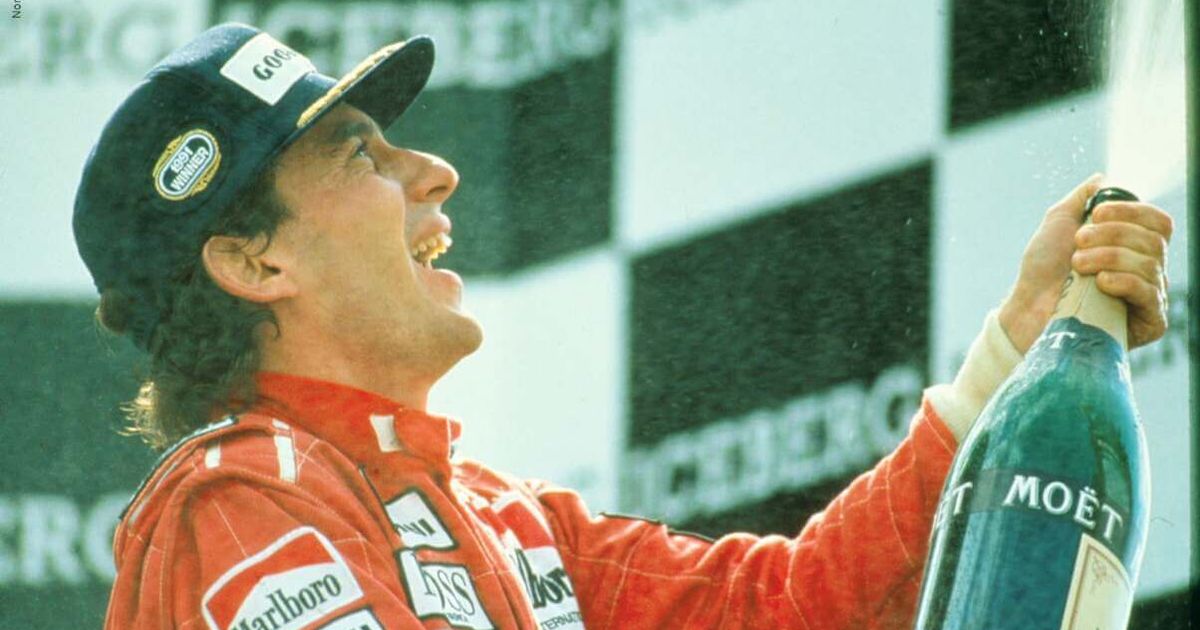
In 1991 he became, at thirty-one, a three-time world champion. The most-remembered race of the year was not the title-decider; it was the Brazilian Grand Prix at Interlagos. He had never won his home race. The fans expected him to win it; the gearbox of his McLaren, in the closing laps, decided otherwise. Sixth gear was the only one left. He managed the final laps in a single ratio, lost almost all of his lead, but held on to take the win.
What you hear on the radio from the closing laps of that race is not a clinical sequence of pit-wall instructions. It is a man screaming. The often-cited "I don't believe it!" comes from the cool-down lap, when he was struggling to hold his head up because of the strain on his neck and shoulders. He arrived at parc fermé barely conscious. He had to be helped onto the podium. He could not lift the trophy. The image — of the most famous Brazilian sportsman in history collapsing in his country's own arms after a race he had spent his entire career trying to win — remains one of the iconic photographs of the sport.
He won the third title at Suzuka. He arrived in Japan with a comfortable championship lead over Nigel Mansell, who departed the circuit on lap ten in a gravel trap. Senna won. He spoke afterwards with a humility that those close to him said was new. The third title, he said, was no longer a project. The next step was to learn what to do with it.
Part Four — The lean years and a move to Williams
1992–1993 — The McLaren of the late turbo era
By 1992 the McLaren had fallen behind the Williams-Renault, which had benefited from the era's most aggressive electronics package — active suspension, traction control, the full electronic toolbox. Nigel Mansell won that year's championship in the FW14B almost by default. Senna finished fourth.
The 1993 season is, depending on whom you ask in the paddock, either the year his career began to wind down or — the view of those who watched closely — the year he was at his absolute peak. The McLaren was no match for the Williams; he won five races anyway, and in places he should have had no business winning at all.
The performance that became the case for the prosecution was the European Grand Prix at Donington Park on 11 April 1993. The race was run in alternating rain and dry conditions that made tyre choice a lottery for everyone. Senna started fourth. By the end of the first lap, he was first. He passed Karl Wendlinger, Michael Schumacher, Damon Hill, and Alain Prost in a single lap of one of the most demanding wet circuits in Britain. By the end of the second lap, he was four seconds clear of the field. The lap is in the YouTube archive, and the only explanation it offers — when you watch it slowly — is that he was operating on a different physical curve to everyone else. Jo Ramírez, McLaren's coordinator, would call those laps the greatest in F1 history.
Senna repeated the wet-weather magic at his home Grand Prix in Interlagos 1993. He took his last F1 victory at the final race of the season, the Australian Grand Prix at Adelaide. Prost — having taken his fourth world title at Williams — was retiring. The two stood next to each other on the podium. They did not embrace. They did stand close enough that a photograph could be taken. It is one of the most photographed images of the rivalry, the famous near-truce. Six months later, Senna would be dead, and Prost would carry his coffin.
1994 — Williams, the FW16, and a sense of foreboding
The deal Senna had pursued for years finally came in late 1993: a Williams seat for 1994. He arrived expecting the package that had won the previous two championships — a Renault engine, an active-suspension chassis, traction control, the full electronic suite. The 1994 regulations had changed. Active suspension, traction control, and most driver aids had been banned. Adrian Newey's FW16 was an aerodynamic concept that had been designed around the active-suspension platform; without the electronics, the car was nervous, unpredictable, prone to understeer in slow corners and a sudden snap at the rear in fast ones.
He completed five races. He failed to finish three of them. Through the early part of the season, he became convinced that the Benetton of Michael Schumacher — winner of the first two rounds — was running illegal traction control, and he said so privately to the team. (The FIA's investigations after the season would be inconclusive but suggestive.) He was driving a car he disliked, against a rival he believed was cheating, in a season that had begun without a point on the board.
The strain was visible. The man who had spent his career projecting an iron certainty was, in private, telling close friends he was anxious about the car's behaviour and uncertain about what 1994 would deliver. None of this was visible on television. He was Ayrton Senna, and the public version of Ayrton Senna did not voice doubt.
Part Five — Imola, 1 May 1994
A weekend that should have been cancelled
The San Marino Grand Prix of 1994, held at the Autodromo Enzo e Dino Ferrari in Imola, was the third round of the season. Senna had not yet scored a point. He arrived in Italy with a competitive obligation that pressed harder than any of his previous championship campaigns: a Williams team that needed a result, a public that expected one, a teammate (Damon Hill) who had finished second in Brazil while he had retired. The season had to start there.
It did not.
On Friday, Rubens Barrichello, the Brazilian rookie who looked up to Senna, crashed at Variante Bassa. He was knocked unconscious and lost teeth, but survived. Senna was the first person to visit him in the medical centre.
On Saturday, in the closing minutes of qualifying, the Austrian rookie Roland Ratzenberger lost a front wing of his Simtek and crashed almost head-on into the wall at Villeneuve corner. He was killed instantly. Senna went to the scene of the accident. He spoke to Sid Watkins, the F1 medical chief and one of his closest friends. According to Watkins's own later account, he asked Senna to retire from the sport on the spot. He told him: you've been three times world champion, you're the fastest man in the world, you like fishing — let's both quit and go fishing. Senna replied: Sid, I can't quit. I have to keep going.
That evening Senna cried. Frank Williams said later he was uncertain through Saturday night whether his lead driver would even take the start. Members of the team who knew him well were certain he would not, on grounds of conscience. Senna himself read the Bible on Sunday morning, opened to a passage that he later told his sister had spoken to him: a verse promising that God would give him the greatest of all gifts — Himself.
The race director's pre-race meeting was tense. Senna led discussions, with several other senior drivers, about reviving the Grand Prix Drivers' Association. They agreed to meet at the next race, Monaco, to draft new safety proposals. Senna was elected, in effect, the lead voice on driver safety for the rest of the season — a role he would not live long enough to fulfil.
The race
The race began with another major accident. JJ Lehto's Benetton stalled on the grid. Pedro Lamy's Lotus, coming up the back of the grid, hit Lehto at high speed. Wheels and debris flew into the crowd, injuring nine spectators. The Safety Car — only the second time it had been used on a dry track in modern Formula 1 — came out, leading the field at a slow pace for five laps while debris was cleared.
The safety car procedure of 1994 was crude. The car was an Opel Vectra — a road car. The pace it set was nowhere near the speed Formula 1 cars are designed to operate at. Tyres cooled. Tyre pressures dropped. Ride-height — already micrometric in 1994's underbody-aero era — fell further as tyres compressed. When the safety car peeled in at the end of lap five and Senna led the field past the start-finish line at full throttle, the Williams was running closer to the ground than its designer had ever intended.
Lap six: he led, heading into Tamburello at full speed.
Lap seven: he disappeared from the television feed.
The 12.8 seconds
The forensic reconstruction, conducted by Italian magistrates over the next three years and by independent engineers including Mauro Forghieri for many years afterward, focused on 12.8 seconds of black-box data — the time elapsed between the start-finish line and the impact at Tamburello. The car was running at over 310 km/h. Engine revs were just under 14,000 rpm. The downforce on the chassis at that speed was approximately four times the car's weight. Senna was experiencing 3.62 g of lateral acceleration through the corner.
Tamburello in 1994 was a fast left-hand kink, almost flat-out, with a narrow run-off and an unprotected concrete wall. Michele Alboreto, who had crashed in the same place years earlier, said in an interview before his own death that the corner could not be missed under normal conditions — only a mechanical failure could put a driver into that wall.
The investigation considered two main hypotheses.
The steering column theory. Williams had modified the column at Senna's request to increase the cockpit's elbow room — the original 22 mm steel cylinder had been welded with an additional 18 mm section. After the crash, the column was found broken. The Italian prosecutors charged Williams personnel with manslaughter on the basis that the modification had been substandard and had failed mid-corner. The defence — supported by the black-box data — was that the column was found to have transmitted a steering torque of 7.18 Nm at the moment of impact, which would not have been possible if it had already failed. The criminal trial dragged on for years; nobody was convicted.
The aerodynamic theory. This is the explanation supported by most engineers who studied the data, including Patrick Head at Williams and the independent investigators. The combination of cooled tyres after the safety car, lower-than-design ride height, and Senna's full commitment through the corner caused the underbody of the Williams to make contact with the asphalt at the apex of Tamburello. Sparks were visible on the live television feed in the seconds before the crash — confirmed by photographic evidence. The bottoming-out stalled the floor's airflow. The downforce that had been pinning the car at four-times-its-weight evaporated for a fraction of a second. Without that downforce, no tyre in the world could have held the corner. The rear stepped out. Senna — with reflexes that the data shows responding within one tenth of a second — applied opposite lock and stood on the brake pedal. The car slowed from 310 km/h to about 211 km/h in the available distance. It hit the wall at an angle that, in any normal circumstance, he would have walked away from.
The thing that killed him was not the impact itself. The car's right front suspension separated from the chassis at the moment of impact and was driven backwards. The right front wheel and a piece of the upper wishbone struck his helmet. Sid Watkins reached him first. Watkins, who had done emergency medicine at the scene of more F1 fatalities than anyone in the sport's history, knew immediately.
"I got him out of the cockpit, got his helmet off, got an airway in," Watkins would later write in his memoir Life at the Limit. "I saw from his neurological signs that it was going to be fatal. He sighed and his body relaxed — that was the moment, although I am not religious, I thought his spirit had departed."
He was airlifted to Maggiore Hospital in Bologna and pronounced dead at 18:40 local time, approximately four hours after the impact.
Part Six — The man
Faith and seriousness
The Senna who showed up to a race weekend was not a charming charisma machine of the kind Formula 1 has tended to produce since. He was small, intense, polite, and occasionally cold. He took the racing — and the people who took the racing — extremely seriously. He had a streak of religious seriousness that his detractors mocked and his teammates eventually came to recognise as the engine of his approach. He read the Bible often. He spoke openly of God in interviews when he felt the question merited it, and refused to discuss the topic when it did not.
He addressed his faith directly more than once. The most-quoted version: the fact that I believe in God, that I have faith in God, doesn't mean that I'm immortal. It doesn't mean that I'm immune. I'm as afraid as anyone of getting hurt, especially driving a racing car. The danger is constant.
The Senna who lived inside the cockpit — the one who decided the 1990 title at Suzuka — was not, in his own description, in conflict with the one who knelt to read scripture. He believed the racing was a vocation. He believed God had given him the talent. He believed it was therefore a moral obligation to use the talent fully. The same logic that produced the 1988 Monaco qualifying lap by 1.4 seconds produced the 1990 collision at Suzuka. To Senna, both were honest. Anything less than full commitment was a form of theft.
Family and the personal life
Senna's first marriage, to Liliane Vasconcelos Souza, was short. They married in 1981, just before he left Brazil for the second time to pursue Formula Ford 2000 in England. They divorced in 1982. In the years that followed, his personal life was conducted away from cameras. He had a long relationship with Brazilian television personality Xuxa Meneghel in the late 1980s. At the time of his death he was engaged to model Adriane Galisteu.
His sister Viviane — older by two years — was the family member he was closest to. His brother Leonardo was, from boyhood, his nightly point of contact during seasons in Europe. His mother Neyde, asked once whether her son would ever stop racing, said in a televised interview: I asked him once. He told me: Mom, when I become world champion, I'll stop. She paused. She added: but I knew that wasn't true. I knew that wasn't who he was.
Inspiration: Brazil and the world
To understand why his death produced three days of national mourning in Brazil — and a funeral attended by an estimated five hundred thousand people — you have to understand the country he raced for. Brazil in the 1980s and early 1990s was a nation that had recently emerged from military dictatorship, was still navigating its first civilian governments, and was struggling with hyperinflation and political instability. Senna's victories were, for many Brazilians, the only consistent good news on television.
He had a habit, after every win, of taking a Brazilian flag from a marshal on the slow-down lap, holding it in one hand, and waving it from the cockpit through the cool-down lap and the podium ceremony. This was the only era in modern Formula 1 where a national flag was a regular feature of post-race imagery, and the only driver who did it. He spoke about his country in interviews in a way no other driver of his era did about theirs — directly, repeatedly, with a personal weight on each word.
A Brazilian fan interviewed in 1994 put it this way: in Brazil we need food, we need education, we need health, and we need a little joy. He gave us the joy.
Charity and the seed of the institute
He had been making private, ad-hoc donations to Brazilian children's organisations for most of his career. By 1991, he had concluded that this was not enough. He told his sister Viviane he wanted to organise it — to build something institutional, planned, large in scale, focused on disadvantaged Brazilian children. He had begun setting aside money, signing structural papers, and scoping the work through the second half of 1993.
He died before the project went public. Viviane Senna founded the Instituto Ayrton Senna in November 1994, six months after his death, on the framework he had begun to build. The institute has, in the three decades since, partnered with thousands of Brazilian public schools and reached millions of children across the country. The seed money came from his estate. The continuing budget comes from licensing his name and image — every t-shirt, every helmet replica, every piece of merchandise sold under his estate's authority funds the work he intended to do himself.
Mentality
Anyone who watched closely talked about the same thing: the seriousness. He demanded of his engineers a depth of communication that exhausted them. He demanded of his teammates a parity of commitment that they could rarely match. He demanded of himself a level of consistency that bordered on the unhealthy. He also had, by all accounts, a real warmth — a smile that lit up when he saw friends, a gentleness with children, a quiet courtesy with team mechanics that those who knew him described as the part of his personality the public never saw.
The most-quoted of all his sayings — if you no longer go for a gap that exists, you are no longer a racing driver — has been treated by half of the racing world as a defence of the 1990 Suzuka collision and by the other half as a mission statement for racing itself. Both are right. He meant it as both.
Part Seven — Career honours and statistics
World Championships — three
1988 McLaren-Honda — 8 wins, 13 poles, 90 points
1990 McLaren-Honda — 6 wins, 10 poles, 78 points
1991 McLaren-Honda — 7 wins, 8 poles, 96 points
Career totals (1984–1994)
161 Grand Prix starts
41 wins
65 pole positions (the record until Michael Schumacher surpassed it in 2006)
80 podium finishes
19 fastest laps
614 career championship points
Junior titles
1977, 1978 South American Karting Champion
1979, 1980 World Karting Championship runner-up
1981 British Formula Ford 1600 Champion
1982 British and European Formula Ford 2000 Champion
1983 British Formula 3 Champion
1983 Macau Grand Prix winner
Signature races
Monaco GP 1984 (Toleman) — 13th to 2nd in the rain at his first Monaco
Portuguese GP 1985 (Lotus) — first F1 win, in the rain, lapped the field
Monaco GP 1988 (McLaren) — qualifying pole by 1.427 seconds in identical machinery
Japanese GP 1988 (McLaren) — first World Championship after a recovery drive from 14th
Brazilian GP 1991 (McLaren) — first home win, gearbox stuck in sixth
European GP 1993, Donington (McLaren) — four overtakes in lap one of a wet race; lap one is widely considered the greatest single lap in F1 history
Australian GP 1993, Adelaide — final F1 victory, last podium with Prost
Records held at the time of his death
Most pole positions in F1 history (65)
Most pole positions at Monaco (5 — also a record at the time)
Most consecutive pole positions (8, 1988–89)
Most wins at Monaco (5 — tied)
Most wins for McLaren-Honda
Posthumous recognition
Brazilian state funeral with three days of national mourning, attended by approximately 500,000 people
Tomb at Morumbi Cemetery, São Paulo — pilgrimage site
Statue at Imola at the corner where he died
Instituto Ayrton Senna, founded November 1994 by Viviane Senna
F1 driver safety reforms following 1994 — HANS device, side-impact protection, circuit run-off redesigns, FIA Institute for Motor Sport Safety. Senna himself argued for these in his last hours; his death produced them
Coda
Three decades after Tamburello, Senna's name still travels through the paddock with a weight that statistics alone cannot explain. Lewis Hamilton has spoken often of him as the driver who made him want to race. Sebastian Vettel chose to wear a Senna-tribute helmet in his last F1 season. Franco Colapinto, the first Argentine in Formula 1 in twenty-five years, told reporters in 2024 that the only photo he carried with him to Europe was of Senna at Interlagos in 1991.
He won three world championships. He could have won four, possibly five. He gave us the wet lap at Monaco, the demolition at Donington, the radio scream at Interlagos, the religious seriousness that turned a sport into a vocation, and a body of work that no driver since has surpassed in pure intensity. He died at thirty-four, still in the middle of his career, with a Bible verse open in his motorhome and an unfinished plan to help the children of his country.
He was Ayrton Senna da Silva, son of Milton and Neyde, brother of Viviane and Leonardo, the boy from Santana. He was Magic. He was unique.